
 by
by How to play
Six rules and a ruler.
Everything is printed on the sheet, so nobody has to remember any of this. It is here for whoever wants to read ahead.
The six rules
Numbered because the order is the point — you cannot call the driver once you have seen the roll.
Pick your line
Lay the ruler on your ball and choose a direction. Any direction at all.
Call the driver now
Before you roll, not after. Say it out loud, so everyone hears you commit.
Roll
Distance is (die + terrain) × driver, and never under 1 cm.
Draw the line
Measure that far along the ruler. The end of the line is your ball. Lines cannot cross the hills — they stop where they meet one.
Water, or off the page
Slide back down your own line to the bank and write +1 beside it.
Within a centimetre is a gimme
One last stroke and you are in.
Two ways to play
Same sheet, same six rules. All that changes is when you point the ruler — and it changes the game completely.
Roll first, then aim
Roll, work out your distance, and only then decide where to point. It becomes a puzzle: given exactly 15 cm, where is the best place to end up? Nobody gets caught out, and a six-year-old can hold their own against the table.
Call it first
Commit to your line and your club, then roll and live with it. Now you are estimating, and the driver is a genuine gamble — you can be aiming at a lovely stretch of fairway and watch yourself sail straight over it into the lake.
Rolling first is worth roughly a stroke a hole. Handy if you want to mix ages at the same table: let the little one roll first and make everyone else call it.
The ground
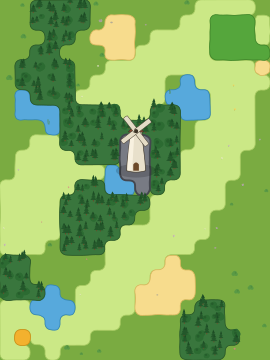
Terrain counts where your ball finishes, so you may shoot clean over water, sand and trees. A hill is the exception: nobody puts a ball through a mountain.
add 1 to the die
take 2 off
take 1 off
take 4 off
+1 stroke, back to the bank
a line cannot cross
putt only, no driver
your ball starts here
Keeping score
Your score is the lines you drew, plus the +1s you wrote.
Which is why a ball in the water slides back to the bank instead of replaying the shot — a replay leaves two lines on one spot and a penalty nobody wrote down. There are four score boxes at the top of every sheet.
Why the courses are any good
For the curious. You do not need to know this to play.
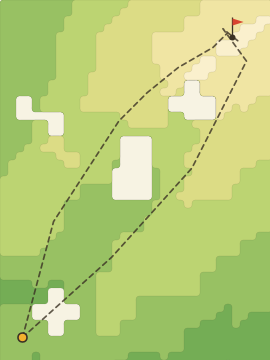
Every hole is played by a computer thousands of times before it is printed, and thrown away if it is dull. This is what it sees: one real hole, shaded by how many shots it should take to finish from each point — pale at the flag, deepening back to the tee.
The two dashed lines are the two ways round. A hole only gets printed if it has at least two, because one way round is just a corridor. The gaps are the hazards, sitting in the middle of play rather than tucked round the edges where they could never catch anybody.
All of which is a long way of saying: no boring holes.
Go and play one
A full hole, free, no account.